Several films are being added to the Criterion Collection, including two films from director Sean Baker and Guillermo del Toro’s feature debut. Check out the full list below of films coming soon to the collection:
Prince of Broadway, Sean Baker
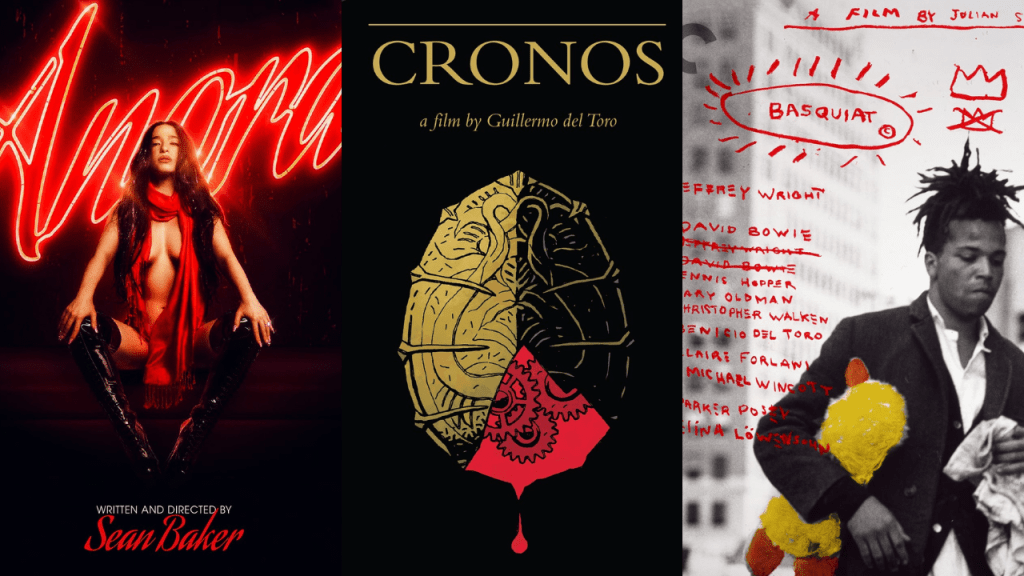
A raw, disarmingly moving slice of neorealism, this early-career triumph from DIY auteur Sean Baker plunges into the world of West African immigrant Lucky (Prince Adu) and his Armenian Lebanese boss Levon (Karren Karagulian), two unlikely friends who peddle knockoff designer goods in Manhattan’s wholesale district. When a long-forgotten ex forces him to take care of a young son he didn’t even know he had, Lucky must figure out how to become a father without losing his edge in the counterfeit-merch game. Capturing the chaos of urban life through expressive handheld camera work, remarkably naturalistic performances, and flashes of manic humor, Prince of Broadway is one of Baker’s most vivid explorations of the illusory nature of the American dream.
Basquiat, Julian Schnabel
Julian Schnabel’s tribute to his friend and fellow painter Jean-Michel Basquiat is less a conventional biopic than an impressionistic, sensory immersion into the much-mythologized downtown-Manhattan art world of the 1980s. Jeffrey Wright, in his first lead film role, stars as the visionary artist whose rise from graffiti tagger to art star forces him to confront the glare of sudden fame, along with racism, his own struggles with addiction, and the difficulties of being self-determining and free in America. Bolstered by an ensemble cast that includes a sublime performance by David Bowie channeling Andy Warhol, Schnabel’s directorial debut—presented here in the filmmaker’s own luminous black-and-white remastering—is a profoundly expressive elegy for a radiant life cut short.
Anora, Sean Baker
Contemporary cinema’s foremost chronicler of American dreamers and schemers hustling on the margins of capitalist promise, Sean Baker, reaches new heights of mastery with this audacious anti–Cinderella story—a whirlwind neorealist screwball comedy with an aching heart. In an electric, star-is-born performance, Mikey Madison soars as Anora, an enterprising, ferociously foulmouthed Brooklyn erotic dancer and sex worker whose Prince Not-So-Charming comes along in the form of a Russian oligarch’s wild-child son (Mark Eydelshteyn). This is the beginning of a fractured fairy tale—also featuring standout performances from Karren Karagulian, Yura Borisov, and Vache Tovmasyan—that turns the cruel realities of class inside out. Winner of the Palme d’Or at the 2024 Cannes Film Festival, Anora confirms Baker as one of our preeminent auteurs.
Jean de Florette / Manon of the Spring, Claude Berri
A sprawling tale of greed, betrayal, and revenge plays out amid the bucolic splendor of the French countryside in Claude Berri’s masterly two-film adaptation of a literary work by the legendary Marcel Pagnol. Spanning three generations in the lives of two families, Jean de Florette and Manon of the Springvividly recreate the provincial world of an early-twentieth-century village, where an outsider’s arrival sets in motion a devastating chain of events. With gorgeous cinematography, keen insights into human nature, and superb performances from icons of French cinema (Gérard Depardieu, Yves Montand, Daniel Auteuil, and Emmanuelle Béart), these richly absorbing moral tales—at the time of their production, the most expensive French films ever made—are triumphs of epic storytelling in the classical tradition.
Chungking Express, Wong Kar Wai
The whiplash, double-pronged Chungking Express is one of the defining works of 1990s cinema and the film that made Wong Kar Wai an instant icon. Two heartsick Hong Kong cops (Takeshi Kaneshiro and Tony Leung Chiu Wai), both jilted by ex-lovers, cross paths at the Midnight Express take-out food stand, where the ethereal pixie waitress Faye (Faye Wong) works. Anything goes in Wong’s gloriously shot and utterly unexpected charmer, which cemented the sex appeal of its gorgeous stars and forever turned canned pineapple and the Mamas & the Papas’ “California Dreamin’” into tokens of romantic longing.
Some Like It Hot, Billy Wilder
One of the most beloved films of all time, this sizzling masterpiece by Billy Wilder set a new standard for Hollywood comedy. After witnessing a mob hit, Chicago musicians Joe and Jerry (Tony Curtis and Jack Lemmon, in landmark performances) skip town by donning drag and joining an all-female band en route to Miami. The charm of the group’s singer, Sugar Kane (Marilyn Monroe, at the height of her bombshell powers), leads them ever further into extravagant lies, as Joe assumes the persona of a millionaire to woo her and Jerry’s female alter ego winds up engaged to a tycoon. With a whip-smart script by Wilder and I. A. L. Diamond, and sparking chemistry among its finely tuned cast, Some Like It Hot is as deliriously funny and fresh today as it was when it first knocked audiences out several decades ago.
Ugetsu, Kenji Mizoguchi
By the time he made Ugetsu, Kenji Mizoguchi was already an elder statesman of Japanese cinema, fiercely revered by Akira Kurosawa and other directors of a younger generation. And with this exquisite ghost story, a fatalistic wartime tragedy derived from stories by Akinari Ueda and Guy de Maupassant, he created a touchstone of his art, his long takes and sweeping camera guiding the viewer through a delirious narrative about two villagers whose pursuit of fame and fortune leads them far astray from their loyal wives. Moving between the terrestrial and the otherworldly, Ugetsu reveals essential truths about the ravages of war, the plight of women, and the pride of men.
Choose Me, Alan Rudolph
An achingly romantic neon dream, Alan Rudolph’s comic and cutting exploration of the mysteries of human desire established him as one of the most boldly idiosyncratic independent auteurs of the 1980s. At the smoky dive Eve’s Lounge, a collection of strangers—including an insecure radio sexpert (Geneviève Bujold), a commitment-phobic former sex worker (Lesley Ann Warren), and a globe-trotting mystery man (Keith Carradine)—become entangled in a web of passion, jealousy, and self-discovery. Grooving to the rhythms of Teddy Pendergrass’s sexy slow jams, Choose Me exists on its own offbeat wavelength—knotty, surprising, and deeply tender in its vision of lost souls wounded by love yet still reaching out for human connection.
A Woman of Paris, Charles Chaplin
Remarkable for its psychological nuance and its boldly modern perspective on an independent woman’s search for fulfillment, Charlie Chaplin’s long-overlooked silent masterpiece A Woman of Paris is a revelation. Chaplin confounded 1923 audiences with this unexpected foray into serious drama, and by ceding the spotlight to his longtime screen partner Edna Purviance. She is captivating as the vivacious Marie St. Clair, a “woman of fate” who leaves behind her small-minded village for the glamour of Paris, where she finds herself at the center of a Jazz Age whirl of champagne soirees, luxurious pleasure-seeking, romance, and tragedy. Putting aside his Little Tramp persona, Chaplin’s second feature proved that, beyond being a comic genius, he was an artist of immense sensitivity and human understanding.
Godzilla vs. Biollante, Kazuki Omori
Diving into delirious realms of imagination, this second film of the Godzilla franchise’s 1980s resurgence showcased the towering beast for a new generation of fans. This time, Godzilla’s foe is one of the series’ most wondrously strange kaiju creations: Biollante—a mutant plant genetically engineered from the cells of a rose, a renegade scientist’s dead daughter, and Godzilla itself. With a wild plot encompassing spies, psychic children, and bonkers biotechnology—and some of the coolest special effects in the history of Japanese cinema—Godzilla vs. Biollante stands as a high point in the ever-evolving mythology of the King of the Monsters.
Thief, Michael Mann
The contemporary American auteur Michael Mann’s bold artistic sensibility was already fully formed when he burst out of the gate with Thief, his debut feature. James Caan stars, in one of his most riveting performances, as a no-nonsense ex-con professional thief planning to leave the criminal world behind after one last score—but he discovers that escape is not as simple as he’d hoped. Finding hypnotic beauty in neon and rain-slick streets, sparks and steel, Thief effortlessly established the moody stylishness, tactile approach, and drama that would also define such later iconic Mann films as Heat, The Insider, Ali, and The Last of the Mohicans.
The Wages of Fear, Henri-Georges Clouzot
In a squalid South American oil town, four desperate men sign on for a suicide mission to drive trucks loaded with nitroglycerin over a treacherous mountain route. As they ferry their explosive cargo to a faraway oil fire, each bump and jolt tests their courage, their friendship, and their nerves. The result is one of the greatest thrillers ever committed to celluloid, a white-knuckle ride from France’s legendary master of suspense Henri-Georges Clouzot.
Cronos, Guillermo del Toro
Guillermo del Toro made an auspicious and audacious feature debut with Cronos, a highly unorthodox tale about the seductiveness of the idea of immortality. Kindly antiques dealer Jesús Gris (Federico Luppi) happens upon an ancient golden device in the shape of a scarab, and soon finds himself the possessor and victim of its sinister, addictive powers, as well as the target of a mysterious American named Angel (a delightfully crude and deranged Ron Perlman). Featuring marvelous makeup effects and the haunting imagery for which del Toro has become world-renowned, Cronos is a dark, visually rich, and emotionally captivating fantasy.
Performance, Donald Cammell and Nicolas Roeg
The grimy criminal underworld and hedonistic rock-and-roll counterculture of late-1960s London collide in this mind-scrambling, kaleidoscopic freak-out. On the run from his vengeful boss, a ruthless gangster (James Fox) hides out in the Notting Hill home of a reclusive rock star (Mick Jagger) and his companions (Anita Pallenberg and Michele Breton), who open the doors of his perception as the lines between reality and fantasy, male and female, persona and self, dissolve in a hallucinogenic haze. Built around Jagger’s most magnetic narrative-film performance, this visionary collaboration between Donald Cammell and Nicolas Roeg is a daringly transgressive, endlessly influential journey to the dark side of bohemia.
Drugstore Cowboy, Gus Van Sant
Gus Van Sant’s dreamy, drifty, deadpan second feature—an addiction drama based on James Fogle’s autobiographical novel—captures the zonked-out textures and almost surreal absurdity of a life lived fix to fix. Swinging between dope-fueled disconnection and edgy paranoia, Matt Dillon plays the leader of a ragtag crew (also featuring Kelly Lynch, Heather Graham, and James Le Gros) that robs pharmacies for pills, coasting across the 1970s Pacific Northwest while trying to outrun sobriety and fate. With a brilliant supporting turn from counterculture high priest William S. Burroughs and a lyrical feeling for the streetscapes of Van Sant’s hometown of Portland, Oregon, Drugstore Cowboy cemented the director’s status as a preeminent poet of outsiderhood.
Crossing Delancey, Joan Micklin Silver
Joan Micklin Silver’s wonderfully affectionate spin on the romantic comedy infuses the genre with a fresh, personal perspective, following an unmarried Jewish woman’s search for fulfillment in New York City. Happily independent bookstore manager Izzy (a luminous Amy Irving) isn’t looking for love, but she’s forced to reevaluate her desires when she catches the eye of two very different men: a self-centered novelist (Jeroen Krabbé) and the mild-mannered Lower East Side pickle seller (Peter Riegert) with whom her old-fashioned bubbie (scene-stealing Yiddish-theater star Reizl Bozyk) sets her up. A love letter to 1980s Manhattan shot in beautifully burnished, autumnal tones, Crossing Delancey gracefully captures the magic of a city where disparate cultures, generations, and traditions both clash and connect.
King Lear, Jean-Luc Godard
Jean-Luc Godard’s first English-language narrative feature is a radical anti-adaptation of Shakespeare’s masterpiece that finds the visionary filmmaker continuing to reinvent the syntax of cinema. In a post-Chernobyl world where culture has been lost, William Shakespeare Jr. V (played by theater director Peter Sellars) attempts to reconstruct his ancestor’s play, abetted by a cast that includes Molly Ringwald, Burgess Meredith, and Godard himself as a crazed avant savant. Through a dense layering of sounds, images, and ideas about everything from language to the economics of filmmaking to the very meaning of art in a ruined world, Godard fashions a puckish and profound metacinematic riddle to be endlessly analyzed, argued over, and savored.
Punch-Drunk Love, Paul Thomas Anderson
Chaos lurks in every corner of this giddily off-kilter foray into romantic comedy by Paul Thomas Anderson. Struggling to cope with his erratic temper, novelty-toilet-plunger salesman Barry Egan (Adam Sandler, demonstrating remarkable versatility in his first dramatic role) spends his days collecting frequent-flier-mile coupons and dodging the insults of his seven sisters. The promise of a new life emerges when Barry inadvertently attracts the affection of a mysterious woman named Lena (Emily Watson), but their budding relationship is threatened when he falls prey to the swindling operator of a phone sex line and her deranged boss (played with maniacal brio by Philip Seymour Hoffman). Fueled by the careening momentum of a baroque-futurist score by Jon Brion, the Cannes-award-winning Punch-Drunk Love channels the spirit of classic Hollywood and the whimsy of Jacques Tati into an idiosyncratic ode to the delirium of new romance.
Winchester ‘73, Anthony Mann
Noirish shadows spread across the frontier in this landmark western, the first of the celebrated collaborations between director Anthony Mann and actor James Stewart that redefined the genre with their moral and psychological intensity. Beginning his midcareer transition into increasingly edgy roles, Stewart portrays an avenging sharpshooter whose stolen rifle becomes a harbinger of death as it is passed from one doomed hand to the next. Featuring a stellar cast that includes a touching Shelley Winters, a sensationally sleazy Dan Duryea, and a pre-stardom Rock Hudson, this elemental tale of violence begetting violence broke new ground with its evocation of the West as a no-man’s-land of antiheroes and villains.
The Grifters, Stephen Frears
A dark-hearted neonoir comes to a boil under the bright Los Angeles sun, in British director Stephen Frears’s rousing adaptation of the novel by dime-store bard Jim Thompson, a film that raises pulp to the realm of existential tragedy. A possessive mother (Anjelica Huston), her cynical son (John Cusack), and his scheming, seductive girlfriend (Annette Bening) are career swindlers circling one another in an elaborate emotional confidence game that grows increasingly perverse as love and trust turn to betrayal and Oedipal undercurrents rise to the surface. In Frears’s first film made in Hollywood, the ever-assured director and his trifecta of magnetic actors conjure a moody, unstuck-in-time vision of toxic Americana.



 Culture Elixir
Leave a comment