
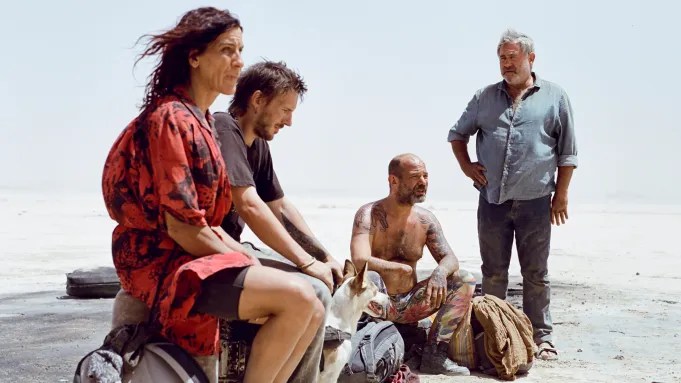
Óliver Laxe’s Sirât is a film that has lingered with me since watching it. Reading the logline, I expected it to play out in a whole different way, but this film surprised me in the most gut-wrenching way. I expected a film about bonding, but not a film centered on trauma-bonding.
The film opens with tons of people in the desert dancing to electronic music, and see a father (Luis played by Sergi López) and son (Esteban played by Bruno Núñez Arjona) handing out flyers of a missing woman (their daughter and sister called Mar.) Eventually, they run into a small group of friends (Stef, Jade, Tonin, Bigui, and Josh) that lets them know they haven’t seen Mar, but that there is another rave happening deeper in the desert and that Mar could potentially be going. After learning this, soldiers quickly shut down the party, leading to a chaotic escape for the ravers. Stef, Jade, Tonin, Bigui, and Josh try to escape without Luis and Esteban, but the father and son duo insist on following them.
On their trip through the desert, the two groups begin to bond. Luis pays for their gas, and the ravers help Luis and Esteban’s small van cross a body of water. Stef even gives Esteban a new hairstyle, and Tonin performs a sort of puppet show for the group. These moments of bonding and friendship begin to soften Luis, and just when you think things will be alright, the rug is pulled from under your feet.
I don’t want to go into detail about these moments as to avoid spoilers, but when you see them, you’ll understand. The small victories the two groups encounter take a complete 180 and all I can say is that you will be left shocked and heartbroken. Amongst the two groups’ very personal conflicts, this is all set during World War III, which also directly impacts the group.
While the film follows Luis and Esteban’s journey to find Mar, I think a major point of the film is the tragedy of war and the way that the innocent suffer. These are two groups that were simply trying to live (Luis and Esteban wanted to find Mar, and the ravers…well they just wanted to dance!), and war further exacerbates their issues. This is further pushed by the film’s hypnotic and trance-like score. Music is universal, and something that is a major bonding point for the two groups. A moment that really struck me was when Luis is finally letting go of his pain, and starts to dance. Seeing a man that didn’t even consider the genre music, a man with so much pain letting go, was so moving.
The music and the film’s characters are set amongst the backdrop of the sweltering desert; a beautiful yet isolating environment that completely encompasses the group. The many extremes that are present in the desert from scorching heat, dust storms and rain and cold really add another element to the film’s story. The desert directly represents each of the characters’ emotional states: isolation, pain and change. On another note, I also loved the moments when the lights from the raves would create drawings on the mountains. The film really touched on so many levels both visually and audibly.
Overall, Sirât really amazed me (and continues to do so), and I’m so glad to have been able to see it in a theater. I cannot stress enough the importance of seeing this on the biggest and loud screen possible.With its mesmerizing visuals, incredible score and heartbreaking performances, this is one that cannot be missed.



 Culture Elixir
Leave a reply to A Father Searches for His Daughter in the Trailer for ‘SIRĀT’ – Culture Elixir Cancel reply